
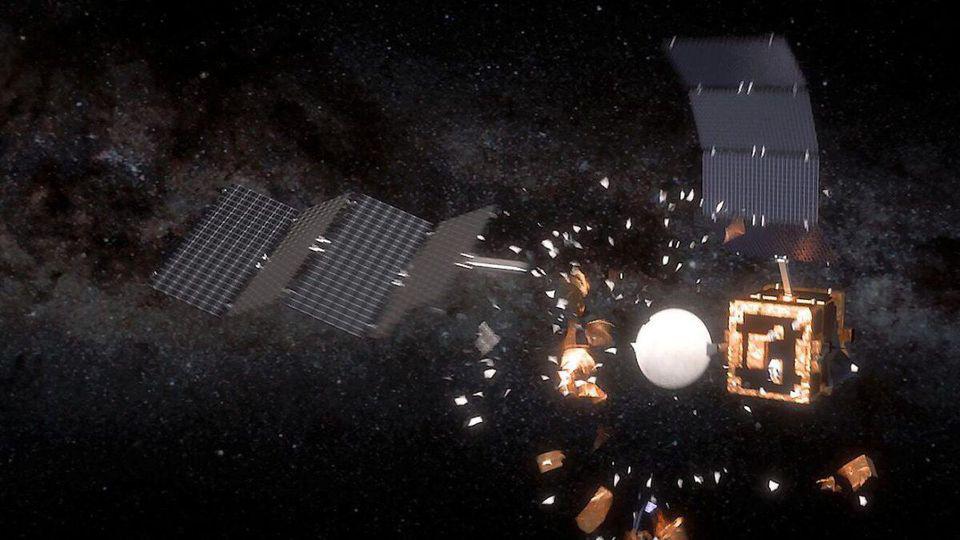
 The collision of two satellites can create hundreds of thousands of pieces of debris, most of which are very small but very fast-moving: up to ~10 km/s. If enough satellites are in orbit, this debris could set off a chain reaction, rendering the environment around Earth practically impassable.
Credit: ESA/Space Debris Office
Key Takeaways
The collision of two satellites can create hundreds of thousands of pieces of debris, most of which are very small but very fast-moving: up to ~10 km/s. If enough satellites are in orbit, this debris could set off a chain reaction, rendering the environment around Earth practically impassable.
Credit: ESA/Space Debris Office
Key Takeaways
- Our scientific picture of reality has been constructed painstakingly, over centuries and millennia, by gathering enormous suites of evidence and rejecting all theories that fail to explain what we observe.
- Through this, we’ve learned about the laws that govern the Earth, fundamental particles, atoms and molecules, our environment, the Universe, and more, refining and enhancing them, over time, wherever possible.
- But here in 2025, many of the lessons we’ve learned, although still true, have fallen out of favor, having been replaced by untrue sentiments that now dominate public discourse. Still, the truth remains true, and everyone should know what it is.
 Sign up for the Starts With a Bang newsletter
Travel the universe with Dr. Ethan Siegel as he answers the biggest questions of all.
Subscribe
Sign up for the Starts With a Bang newsletter
Travel the universe with Dr. Ethan Siegel as he answers the biggest questions of all.
Subscribe
No matter what it is that humans do — what we think, feel, accomplish, believe, or vote for — our shared scientific reality is the one thing that unites us all. The same laws and rules govern everything within this cosmos. We’re all composed of the same raw ingredients, those ingredients obey the same fundamental laws at all times and in all places, but the way that those ingredients evolve can lead to vastly different outcomes with only the most minuscule changes in their initial configuration or environment. Moreover, some of the quantum rules that govern reality are fundamentally indeterminate, limiting our ability to predict a system’s future behavior from even an arbitrarily well-known starting point.
Still, scientific truths remain true, even if there are very few who accept them. Gravity worked for billions of years before humans figured out the rules that govern massive objects. Life formed, thrived, and evolved for billions of years before humans discovered evolution, genetics, and DNA. Humans are impacting the planet in profound ways, from ecology to environment and beyond, and those impacts remain true and relevant to life on our world whether we recognize it or not.
Science has brought us so far in this world, enabling innumerable discoveries and technologies, and making what was once thought impossible now routine. However, many scientific truths have fallen out of public favor in recent times. Now, in 2025, some of the misinformation that’s replaced those truths has been elevated to prominence, and many cannot tell fact from fiction any longer. Whether you believe them or not, here are 10 scientific truths that remain true, even though you might not realize it here in the final month of 2025.
 Although the carbon dioxide mole concentration has increased from below 320 ppm in 1960 to a peak of more than 430 ppm at the highest point in 2025, the CO2 concentration has accelerated in recent years, with 2023 and 2024 showing increases of more than 3 ppm year-over-year. Compared to the pre-industrial value of 270 ppm, CO2 levels are at their highest in millions of years.
Credit: NOAA/Global Monitoring Laboratory
Although the carbon dioxide mole concentration has increased from below 320 ppm in 1960 to a peak of more than 430 ppm at the highest point in 2025, the CO2 concentration has accelerated in recent years, with 2023 and 2024 showing increases of more than 3 ppm year-over-year. Compared to the pre-industrial value of 270 ppm, CO2 levels are at their highest in millions of years.
Credit: NOAA/Global Monitoring Laboratory
1.) 2024, the latest full year on record, saw the highest CO2 levels and the highest average temperatures since we first began tracking them.
Prior to the industrial revolution, planet Earth had a well-quantified global average temperature and a well-quantified average carbon dioxide concentration (of around 270 parts-per-million) in the atmosphere, despite minor seasonal variability. As was reported in January of 2025, 2024 was the world’s hottest year on record, becoming the first calendar year to pass the threshold of 1.5 °C of global warming since the start of the industrial revolution. Similarly, CO2 concentrations jumped by 3.58 parts-per-million in 2024: breaking the previous record set in 2023 of 3.36 ppm of annual increase.
The global atmospheric concentration of CO2, at the start of the year, was 427 ppm, and peaked at a high of 430 ppm in May before falling again in subsequent months. The increase in CO2 concentrations drive the increase in global average temperatures: a phenomenon well-known and well-understood for more than 50 years, despite misinformation produced by the US government this year contradicting that claim. Moreover, not only is the Earth continuing to warm, but the warming trend and our greenhouse gas emissions are both accelerating. Many minimize or even deny this outright, but it remains true whether anyone believes it or not.
 These flux maps show the spectrally integrated flux for 3I/ATLAS observed with JWST’s NIRSpec instrument, showing scattered light from coma dust at 1.2 microns (panel a), carbon dioxide at 4.3 microns (panel b), water at 2.7 microns (panel c), and carbon monoxide at 4.7 microns (panel d). Note the weak, consolidated nature of the water and carbon monoxide, compared to the bright, diffuse carbon dioxide signal.
Credit: M. Cordiner et al., Astrophysical Journal Letters submitted, 2025
These flux maps show the spectrally integrated flux for 3I/ATLAS observed with JWST’s NIRSpec instrument, showing scattered light from coma dust at 1.2 microns (panel a), carbon dioxide at 4.3 microns (panel b), water at 2.7 microns (panel c), and carbon monoxide at 4.7 microns (panel d). Note the weak, consolidated nature of the water and carbon monoxide, compared to the bright, diffuse carbon dioxide signal.
Credit: M. Cordiner et al., Astrophysical Journal Letters submitted, 2025
2.) Interstellar interlopers are real, and while we found a new one (only the third ever) in 2025, they are still not aliens.
For as long as we’ve been looking up, humans have noticed changes in the night sky. This includes the phases of the Moon, the motions of the planets, the phenomenon of eclipses, the appearances of “new stars,” and the occasional visit from comets and asteroids. Starting in 2017 with the discovery of ‘Oumuamua, we realized it wasn’t just comets and asteroids that plunged through the inner Solar System, but also interstellar interlopers: objects that originated from elsewhere within the galaxy. In 2019, Borisov became the second such object known, and this year, interstellar comet 3I/ATLAS became the third.
It’s fascinating for an enormous variety of reasons: it’s the oldest, fastest-moving object ever detected in our Solar System, and seeing it up close brought us a wealth of knowledge about its composition and other properties. However, the most far-reaching claim about this object is also the one with absolutely no scientific evidence behind it: the notion that it either is itself or provides evidence for alien life and intelligence.
Those claims are not based in science; they are based in grift and have no meritorious backing to them, as many have pointed out repeatedly. Regardless of what you believe (or what anyone believes), this object is a natural comet-like interloper originating from beyond our Solar System, and has absolutely nothing to teach us about alien life beyond Earth.
 This figure shows the NIRCam (top) and NIRSpec (bottom) data for now-confirmed galaxy MoM-z14: the most distant galaxy known to date as of May 2025. Completely invisible at wavelengths of 1.5 microns and below, its light is stretched by the expansion of the Universe. Emission features of various ionized atoms can be seen in the spectrum, below, as well as the significant and strong Lyman break feature.
Credit: R.P. Naidu et al., Open Journal of Astrophysics (submitted)/arXiv:2505.11263, 2025
This figure shows the NIRCam (top) and NIRSpec (bottom) data for now-confirmed galaxy MoM-z14: the most distant galaxy known to date as of May 2025. Completely invisible at wavelengths of 1.5 microns and below, its light is stretched by the expansion of the Universe. Emission features of various ionized atoms can be seen in the spectrum, below, as well as the significant and strong Lyman break feature.
Credit: R.P. Naidu et al., Open Journal of Astrophysics (submitted)/arXiv:2505.11263, 2025
3.) We broke the record for most distant galaxy ever found but still haven’t spotted the first generation of stars.
It’s a claim that rears its head every few years: that astronomers, having looked at an ancient galaxy, have good reason to suspect that inside that collection of stars, gas, dust, and more, they have spotted an example of pristine, Population III stars for the first time. In theory, we must have formed stars from material left over from the Big Bang for the first time at some point, and then all subsequent generations of stars will have arisen from the ashes of that first generation of stars.
However, good evidence for the first stars would be unambiguous: with no “later generation stars” alongside them to pollute the signal, and with a robust set of spectroscopic data to show that the stars in this particular region weren’t just blue in color, but exhibited a lack of carbon, oxygen, and all the heavy elements that stars are required to create. While yet more claims have arisen here in 2025 that assert, “maybe we have found the first Population III stars” after all, the facts are that:
- we haven’t gathered sufficient data to support such a claim,
- and instead are faced with the reality that such a detection is likely beyond JWST’s capabilities.
The search will continue, but we have to brace ourselves that the unsupported claims will also likely continue. Until we’ve cleared the necessary standards of evidence for a robust detection, the mystery will still be hiding somewhere within the first ~280 million years of cosmic history.
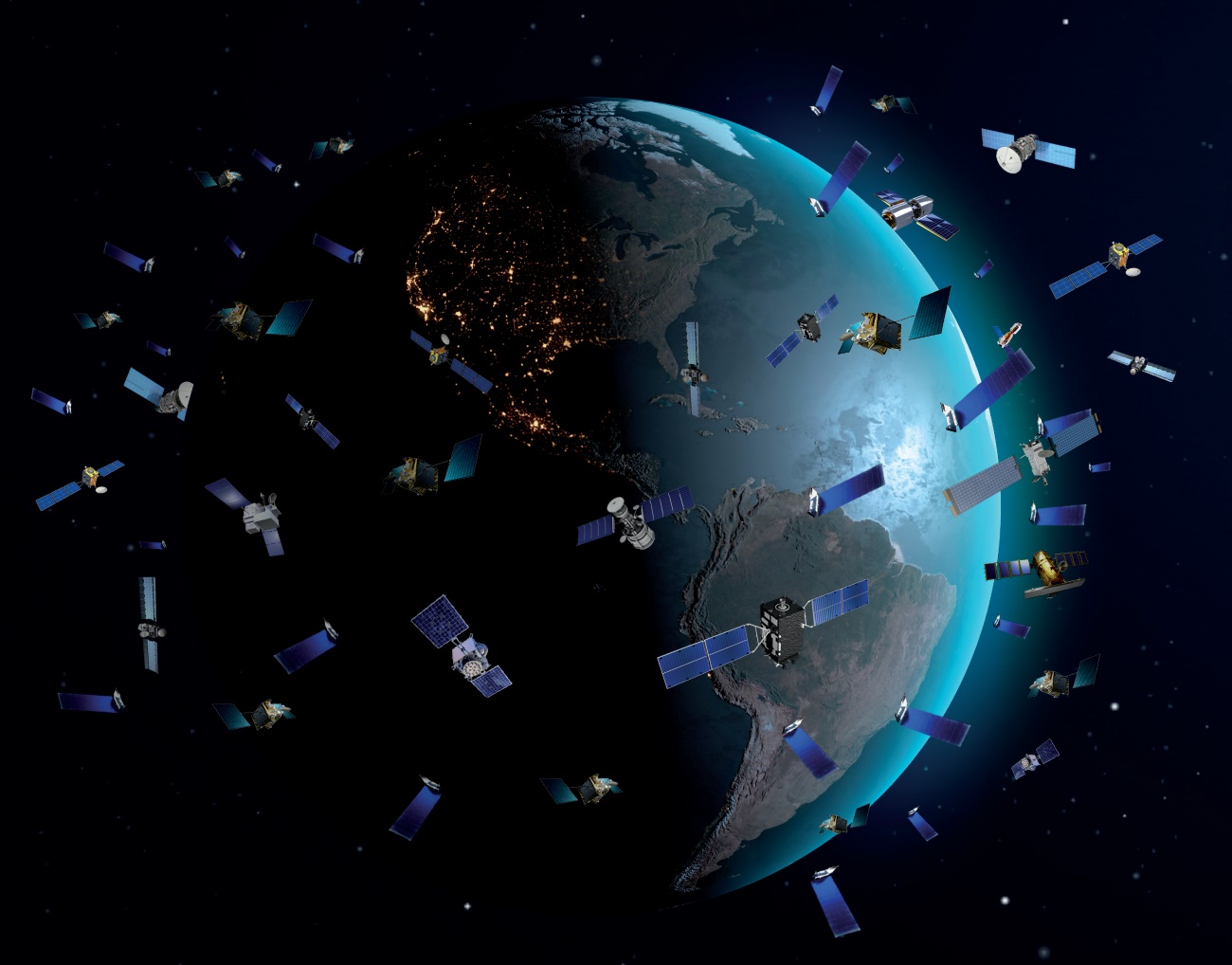 There are over 40,000 pieces of tracked space debris and tens of thousands of satellites in orbit around Earth today. While many occupy low-Earth orbit, there are a large number of objects whose orbits extend many thousands of miles/kilometers away from the Earth. With enough objects in low-Earth orbit, a solar flare will potentially disable them, leading to not only a collision, but a chain reaction of collisions. In the worst-case scenario, Kessler syndrome becomes a real risk.
Credit: NOIRLab/NSF/AURA/P. Marenfeld
There are over 40,000 pieces of tracked space debris and tens of thousands of satellites in orbit around Earth today. While many occupy low-Earth orbit, there are a large number of objects whose orbits extend many thousands of miles/kilometers away from the Earth. With enough objects in low-Earth orbit, a solar flare will potentially disable them, leading to not only a collision, but a chain reaction of collisions. In the worst-case scenario, Kessler syndrome becomes a real risk.
Credit: NOIRLab/NSF/AURA/P. Marenfeld
4.) Earth’s orbit has a finite “carrying capacity,” and if we exceed that, such as with megaconstellations of satellites, it will inevitably lead to Kessler syndrome.
Back at the start of 2019, there were right around 2000 active satellites in orbit around planet Earth. Here in 2025, there were 3000 now-active Starlink satellites — satellites that are part of just one company’s megaconstellation — that were launched just this year, alone. Many other companies are launching their own satellites as well, some of which are very high-impact, large, reflective, and heavily light-polluting. As of December 7, 2025, there are more than 17,000 satellites in orbit around Earth, with announced plans to increase that number into the many hundreds of thousands over the next few years.
The problem is that if you have too many satellites in a thin “shell” of volume around the Earth, the risk of collisions becomes high. If you have no way to mitigate the effects of space weather (solar flares, the solar wind, coronal mass ejections, etc.) on those satellites, then there will be times where they will be inoperable and incommunicable, and where you have no ability to actively avoid collisions. And if there are enough objects, then once the first collision occurs, it could trigger a chain reaction of collisions that could make low-Earth orbit impassable to new rocket launches.
How many satellites is too many? The answer appears to be, “several hundred thousand.” This is the path we’re taking, and unless we address it now, we likely won’t until a disaster has already occurred. Only this time, we’ll be living with the consequences for thousands of years to come.
 This graph shows the estimated percentage of kindergarteners, as of the 2023-2024 school year, with medical or nonmedical exemptions from one or more vaccinations. The overall vaccination rate has declined to ~93% in the United States for all vaccines: its lowest value in the 21st century.
Credit: CDC.gov
This graph shows the estimated percentage of kindergarteners, as of the 2023-2024 school year, with medical or nonmedical exemptions from one or more vaccinations. The overall vaccination rate has declined to ~93% in the United States for all vaccines: its lowest value in the 21st century.
Credit: CDC.gov
5.) The germ theory of disease is real, and vaccination is the safest, most effective strategy to combat these deadly pathogens.
Germs, particularly in the form of protists, bacteria, and viruses, are the most common underlying cause of transmissible infectious diseases in human beings. Over time, medical and biological science has:
- uncovered the link between the underlying pathogen and the symptomatic disease in humans,
- led to the development of methods for treatments, cures, and vaccines against the disease,
- and vaccination has proven, over billions of doses and hundreds of years, to be the safest and most effective strategy for preventing infection and protecting humanity against those diseases.
And yet, today, with more vaccines protecting more humans against more diseases than ever before, with more evidence supporting their safety and efficacy than ever before, trust in vaccines — as evidenced by unsafely-low vaccination rates — is at the lowest level it’s ever been in all of our lifetimes.
It has already led to a resurgence of once-eliminated, vaccine-preventable diseases, including measles. With more infections, there are more adverse consequences: more illnesses, more people who acquire disabilities as a result of those illnesses, more deaths, and a greater potential for disease mutation and for those pathogens to evade the immunity that even the vaccinated population has acquired. In the fight against infectious disease, the anti-vaccine stance is the pro-disease one, and that harms all of humanity.
 This color-coded diagram represents 15 recombinant fragments of various SARS-related beta coronaviruses compared to the original genome of SARS-CoV-2 that first infected humans. Several different strains show a “best match” for a variety of these 15 fragments, indicating a recombination-based origin for SARS-CoV-2, and refuting the feasibility of a lab creation through gain-of-function research.
Credit: S. Temmam et al., Nature, 2022
This color-coded diagram represents 15 recombinant fragments of various SARS-related beta coronaviruses compared to the original genome of SARS-CoV-2 that first infected humans. Several different strains show a “best match” for a variety of these 15 fragments, indicating a recombination-based origin for SARS-CoV-2, and refuting the feasibility of a lab creation through gain-of-function research.
Credit: S. Temmam et al., Nature, 2022
6.) SARS-CoV-2 led to COVID-19 in humans as the result of a natural, zoonotic spillover event, not as the result of a leaked pathogen from a Wuhan Lab in China.
In the spring of 2020, infections from a novel coronavirus began to spike in countries all across the world: in Europe, in the Americas, in Asia, and more. In short order, millions were infected, tens of thousands died, and hundreds of thousands more dealt with what would be the beginning of severe, long-term consequences to their health. Around the same time, a dishonest narrative with no basis in science began appearing: that the virus wasn’t the result of a natural spillover event from nature to humans, but rather came as a result of work that was conducted, perhaps in secret, at the Wuhan Institute of Virology in China.
All of that is nothing more than an unfounded conspiracy: one that’s contradicted by a mountain of biological evidence indicating support for the natural spillover scenario. The most compelling evidence is something that couldn’t be faked or reproduced in the laboratory at all: the evidence written into the mosaic genome of SARS-CoV-2 itself. While governments, including the US government, are fanning these flames, independent fact-checkers have noted that this is just one of hundreds of attacks on science, our scientific infrastructure, and scientific trust that have occurred here in 2025. The attacks do not change the facts; the virus is of natural, not human-made, origin.
 This chart shows the 35 possible galaxies to choose from that have resolvable stars (Cepheids, tip of the red giant branch, or JAGB) and also were host to at least one type Ia supernova. The light red galaxies show which galaxies were included in the CCHP results; the dark red were excluded.
Credit: A. Riess, CMB@60 Meeting, 2025
This chart shows the 35 possible galaxies to choose from that have resolvable stars (Cepheids, tip of the red giant branch, or JAGB) and also were host to at least one type Ia supernova. The light red galaxies show which galaxies were included in the CCHP results; the dark red were excluded.
Credit: A. Riess, CMB@60 Meeting, 2025
7.) The Universe’s expansion is still accelerating, the Hubble tension remains an important puzzle, and the much-publicized evidence we have is insufficient to conclude that dark energy is evolving.
The Universe is expanding, as was established in the late 1920s and early 1930s, and the expansion rate has been accelerating for the past few billion years, as was first established in the late 1990s. Over the past 15 years, there’s been a conundrum over the expanding Universe: the two different methods for measuring its present rate of expansion, the “early relic” method (BAO or CMB) and the “distance ladder” method (where you start here and look out, or back in time, at progressively more distant objects), give incompatible results. The early relic method claims an expansion rate of 67 km/s/Mpc, while the distance ladder method yields results of around 73 km/s/Mpc.
Despite claims that this tension could go away, or that it isn’t robust, or that we still need better data to decide, the Hubble tension remains as a real conundrum that cannot be swept under the rug by claiming that one group is in error. The truth is that these two different methods yield different results, and that cries out for an explanation.
Could dark energy be evolving? Maybe, but that’s not going to solve the Hubble tension, and the evidence in favor of dark energy’s evolution has not yet reached the standards necessary to declare a discovery, while the evidence for the Hubble tension has indeed gotten there. The fate of the Universe may yet be open to revision, but the Hubble tension will remain an interesting puzzle regardless of whether dark energy evolves or not.
 Although the JWST MIRI spectrum of exoplanet K2-18b is consistent with a series of light molecules like methane and carbon dioxide along with DMS and/or DMDS, the “significance” of 3-sigma was only obtained because all other possible gas species that could exhibit a strong absorption feature beginning at 9 microns were excluded from the analysis. There are other strongly viable scenarios that must be considered as well, and when they are, the evidence for DMS and DMDS disappears to be insignificant.
Credit: N. Madhusudhan et al., Astrophysical Journal Letters, 2025
Although the JWST MIRI spectrum of exoplanet K2-18b is consistent with a series of light molecules like methane and carbon dioxide along with DMS and/or DMDS, the “significance” of 3-sigma was only obtained because all other possible gas species that could exhibit a strong absorption feature beginning at 9 microns were excluded from the analysis. There are other strongly viable scenarios that must be considered as well, and when they are, the evidence for DMS and DMDS disappears to be insignificant.
Credit: N. Madhusudhan et al., Astrophysical Journal Letters, 2025
8.) “Passing peer review” doesn’t make a scientific study true; it just means the study is robust enough that it’s passed the “start line” for consideration by the community.
All throughout the year — and this happens every year — a series of new claims about science have promulgated across our shared online discourse, with many assertions that our conventional ways of making sense of the Universe have been upended or overthrown entirely. While that might be an appealing narrative, it simply isn’t true; while the papers challenging the modern scientific consensus may have passed peer review, their conclusions are not necessarily (or even are likely to be) valid.
There’s this big myth that “passing peer review” means that everything written in a paper is correct, whereas the truth is that even the referees and editors routinely disagree with many of the assertions, and sometimes even the core idea of, the paper that they’ve allowed to pass the peer review process. That’s because “passing peer review” is the bare minimum standard that a paper must achieve to be even considered part of the literature, which is required to participate in the grand conversation that professionals working in their field continuously have with one another.
Claims questioning the age of the Universe, the inhabited nature of exoplanets, the non-existence of ultra-large cosmic structures, the evaporation of protons, or making predictions about the date of a nova’s recurrence can all easily be found, and such claims have indeed passed peer review, but they’re all still untrue. Passing peer review is a necessary hurdle to “get your idea’s foot in the door,” but doesn’t necessarily mean that the idea’s merits will take it any further than that.
 This four-panel graph shows the reduction/oxidation processes that occurred in the Bright Angel and Masonic Temple regions within Jezero Crater, as explored by NASA’s Perseverance Rover. The discovery of organic molecules and these sets of reactions hint at, but do not prove, the possible presence of ancient biological activity on Mars.
Credit: J.A. Hurowitz et al., Nature, 2025
This four-panel graph shows the reduction/oxidation processes that occurred in the Bright Angel and Masonic Temple regions within Jezero Crater, as explored by NASA’s Perseverance Rover. The discovery of organic molecules and these sets of reactions hint at, but do not prove, the possible presence of ancient biological activity on Mars.
Credit: J.A. Hurowitz et al., Nature, 2025
9.) We’ve found evidence for organics on Mars (again), but still have no good evidence for life on any planet other than Earth.
It’s important to remember, especially when specious claims about the existence of aliens are at an all-time high, that we still have no robust evidence for the existence of life on any planet or world other than Earth. Sure, other worlds could be inhabited.
- Worlds in our Solar System, including certain planets and several moons, could be home to alien microbes.
- A great many exoplanets could be inhabited, and we may soon be approaching the necessary technology to discover biosignatures on them.
- And there could be intelligent extraterrestrials out there, perhaps even actively searching for others, just awaiting our response.
However, claims of “aliens” are very easy to make, but sufficient evidence indicating their existence is sorely lacking. Whether it’s the Wow! signal, the results of the Viking 1 lander’s experiments, phosphine on Venus, or most recently, organics on Mars, it’s common to find people claiming “we’ve found aliens.” That’s one possible explanation, for sure, but the other (more mundane) ones are notoriously difficult to rule out. Until we’ve risen higher up the Confidence of Life Detection (CoLD) scale, we have to demand more extraordinary evidence for accepting such a revolutionary conclusion.
 This figure shows side-by-side panels for the true force law for planets in our Solar System (blue arrows) and the force laws recovered by an artificial intelligence program given enormous amounts of training data for millions or even billions of synthetic solar systems. Note the complexity, as well as the inconsistency, of the recovered force law using AI.
Credit: K. Vafa et al., ICML 2025/arXiv:2507.06952, 2025
This figure shows side-by-side panels for the true force law for planets in our Solar System (blue arrows) and the force laws recovered by an artificial intelligence program given enormous amounts of training data for millions or even billions of synthetic solar systems. Note the complexity, as well as the inconsistency, of the recovered force law using AI.
Credit: K. Vafa et al., ICML 2025/arXiv:2507.06952, 2025
10.) You still need to know science in order to do it; “vibe science” is nothing more than AI slop.
Here in 2025, there are all sorts of good uses for artificial intelligence in science:
- pattern-finding,
- protein folding,
- handling large data sets,
- searching for rare objects or events,
- optimizing a variety of algorithms,
and so on. However, in contrast to those good uses, there are also a wide variety of “theories of everything” that have arisen from non-expert humans prompting large language models (LLMs) with a repeated series of inquiries, where the LLM will agree that the human’s ideas have merit and will fawningly tell the human that they’re truly onto something profound.
This is not “vibe science” the way one might be able to “vibe code;” this is pure AI slop. In fact, researchers have shown, just this year, that even the best LLMs are catastrophically bad at discovering general laws or rules that a system will obey, even if you give it all the necessary precursor information. For example, given Kepler’s laws and thousands of examples of orbital systems, every LLM failed to derive Newton’s laws, or even the nature of an inverse square law force. For all that we’ve advanced, there’s still no substitute for knowing science, and being trained in its foundations, when it comes to actually conducting science ourselves.
These 10 truths, although they should be completely non-controversial in a world that values factual reality, are often disputed here in 2025. Despite their unpopularity, they’re just as true as they’ve ever been, and will likely remain true for a long time to come. Don’t let anyone convince you otherwise until they’ve obtained the extraordinary evidence needed to convince even a skeptic; if the evidence cannot yet decide the matter, then the matter hasn’t been decided. Better to accept that than to fool ourselves into accepting a false version of reality that never was.
Tags particle physicsSpace & Astrophysics In this article particle physicsSpace & Astrophysics Sign up for the Starts With a Bang newsletter Travel the universe with Dr. Ethan Siegel as he answers the biggest questions of all. Subscribe