 Hyundai
Trying to get your first car as a new driver can sometimes feel like a rite of passage. You save up, stress over every review, scroll through way too many models, and still end up second-guessing whether you're even making the right choice. If you're young, your goal probably might be something that looks fun. And if you're a parent shopping for your kid, your priority would most likely be something safe, reliable, high-quality, and not likely to wipe out an entire savings account with one unlucky repair.
The good thing is that cars like that actually exist. In fact, automakers have started loading their cheapest models with the kind of build quality, tech, and peace of mind that used to be reserved for the top trims. You get to see stuff like touchscreens, backup cameras, collision-avoidance systems, lane-assist features, and shockingly good fuel economy that won't drain your wallet. And because many of these cars hold their value so well, owning one doesn't come with that constant fear of losing money every time you start it up. If you're stepping into the world of driving for the first time, or shopping for someone who is, we've pulled data from sources like J.D. Power, Cars.com, the National Highway Traffic Safety Administration (NHTSA), and more to curate this list of affordable cars that will deliver quality without a heavy price tag behind it.
Honda Civic
 Honda
Honda
When it comes to first cars, the Honda Civic is one of those names that's hard to ignore. It's been around since the '70s, and a big part of its reputation comes from how well it ages. With regular maintenance, Civics are known to cross 200,000 miles without any drama, and even when something pops up, the average annual repair bill is very friendly at $368.
For a 2025 Civic, expect to get standard driver-assistance features across every trim. Inside the base trims, you'll find a 7- or 8-inch touchscreen, Apple CarPlay, Android Auto, and a layout that's easy to understand even if you've never owned a car before. But if you step it up a few trims, you'd get premium packages like a 9-inch display, a 10.2-inch digital cluster, Google built-in, a power moonroof, alloy wheels, and even a 12-speaker Bose audio system.
Even with all that, pricing still stays levelheaded at about $24,250 ($1,150 destination fee) for the least expensive sedan. And because Civics hold their value exceptionally well, you can get a used 2022 model for around $23,000, while an older 2015 Civic can be found for under $10,000, depending on condition.
Toyota Corolla
 Toyota
The Toyota Corolla is one of the most-sold cars in the world. This one has a solid reputation that goes way back to 1966 for clearing 200,000 miles with little more than regular checkups. Even its older models, like those in the 2001 lineup, already had built-in solid basics like defogger, multiple airbags, anti-lock brakes, and aluminum wheels.
After that, Toyota kept refining the formula, culminating in today's 12th-generation iteration. In the latest model, which rides on Toyota's TNGA platform, you can choose between a hybrid with a 1.8-liter engine making 138 horsepower or a stronger 2.0-liter with 169 horsepower. However, inside, base trims come well-equipped with features such as an 8-inch touchscreen, Wi-Fi hotspot, wireless Apple CarPlay and Android Auto, satellite radio, four USB ports, and automatic climate control.
At a starting price of $22,725 ($1,195 destination fee), you'll also find driver aids like lane-departure warning, pedestrian detection, adaptive cruise control, and traffic-sign recognition standard across all trims. And if you want to level up, optional packages will include stuff like a power moonroof, heated seats, alloy wheels, blind-spot monitoring, wireless charging, a JBL premium sound system, and even a 10.5-inch touchscreen.
Mazda 3
 Mazda
Mazda
Ever since the Mazda 3 came out hot back in 2004, it has never looked back. By 2019, it had racked up about 6 million sales and became part of the conversation as a go-to car for new drivers. Brand new, the base trims include an 8.8-inch screen, keyless entry, an eight-speaker stereo, and other features that really don't feel entry-level at all. Step up to higher trims, and those features get even sweeter, with leather touches, nicer wheels, optional AWD, and a more refined suspension that makes the car feel planted. But if you want more push, its 2.5-liter turbo can serve as much as 250 hp and 320 lb-ft of torque on premium gas.
In terms of safety, every one of its trims comes with features such as Smart Brake Support, Lane-Keep Assist, and Blind Spot Monitoring, which help inexperienced drivers stay out of trouble. Mazda also includes a three-year basic warranty in case anything comes up in those early days of ownership. You can slide into a brand new Mazda 3 starting at $24,550 ($1,235 destination fee). If used models are more your style (or budget), there is a marked improvement in quality since the 2015 model year.
Hyundai Elantra
 Hyundai
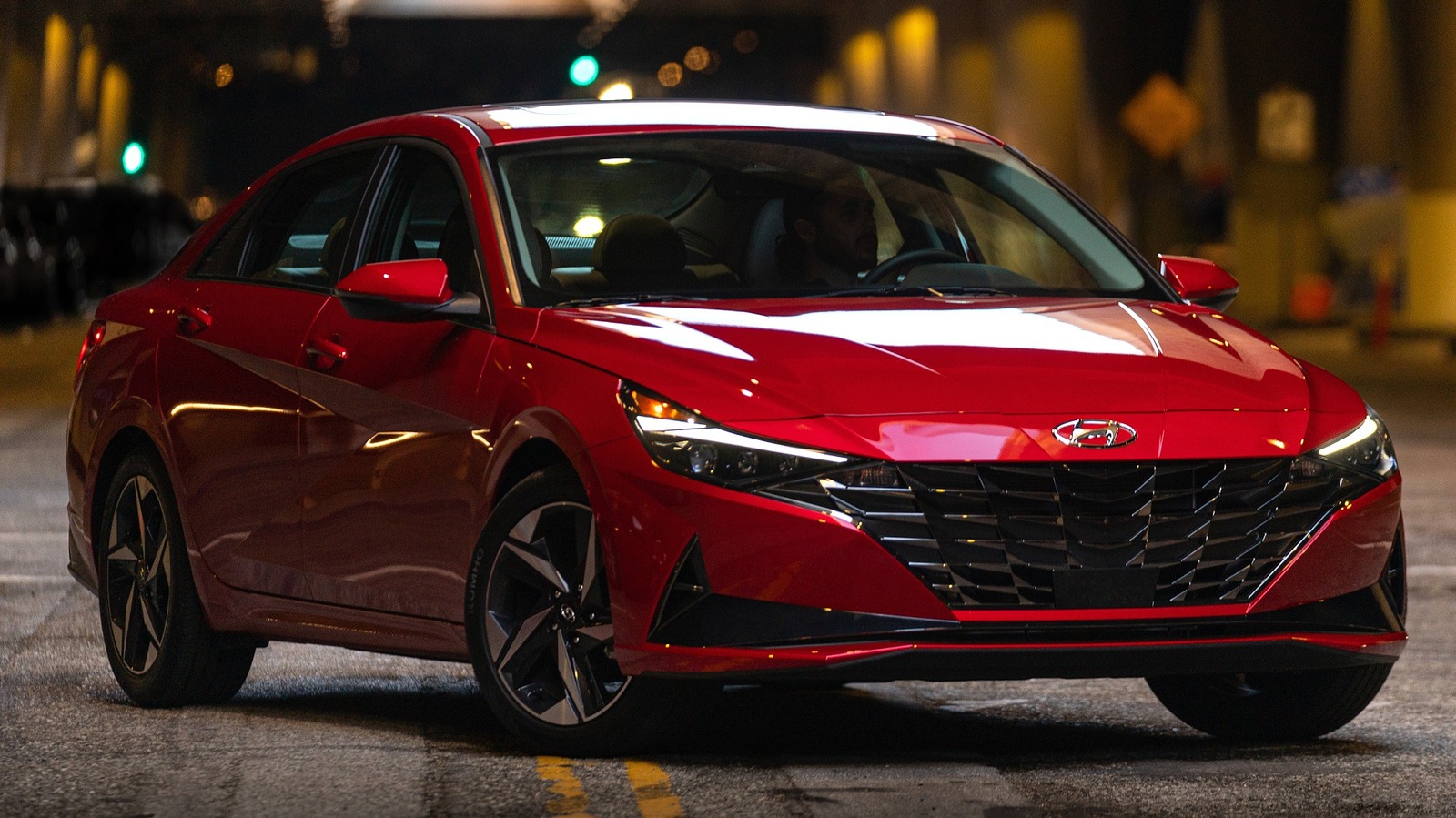
Since the Hyundai Elantra rolled out in 1992, it has been all over America's roads, and that's because it has built a quiet reputation as one of Hyundai's most dependable models in addition to being one of the brand's best-selling cars, with over 15 million units sold worldwide. If you are hunting for your first Elantra, consumers seem to have the most praise for the 2008,2018, and 2021 models. Those years hit that sweet spot for quality and reliability. Car Complaints also reports that the 2013 model year was particularly troublesome, while those built after exhibit a marked decrease in issues.
If a brand-new buy is on your radar, under the hood of the 2025 base models, you'll find a 2.0 inline-four-cylinder that makes around 147 horsepower and 132 lb-ft of torque, paired with a CVT transmission. Along with the package comes a ten-year powertrain warranty if it ever goes sideways. Inside, you'll also find space for five people, basic wireless Apple CarPlay and Android Auto, a touchscreen display, and other tech. For a starting price of around $23,025 with the $1,150 delivery fee included, you'll get safety features like lane-keeping assist, automatic emergency braking, and pedestrian detection, all fully backed by NHTSA's Five-Star rating and the IIHS Top Safety Pick+ award.
Kia Soul
 Kia
Kia
It's hard to talk about Kia's biggest success stories without mentioning the Kia Soul. With 16 years on the road, this car has racked up more than 1.5 million sales in the U.S., thanks in part to its practical affordability. If the 2025 model is on your mind, you can expect to pay about $20,490 ($1,375 delivery fee).
With a combined fuel economy up to 31 mpg, it runs on a 2.0-liter four-cylinder engine that cranks out 147 horsepower and 132 lb-ft of torque. Inside, you'll find a tall roofline and a big cabin that gives both new drivers and passengers that airy vibe you'd expect from a small hatchback. Up front, you'll also find a clean tech layout, including an 8-inch touchscreen on the LX trim, but if upgraded, you'll get a 10.25-inch display that offers both Apple CarPlay and Android Auto for easy connectivity.
All of its trims feature driver-assist systems such as lane-keeping assist and forward-collision warning, which are backed by a "Good" IIHS crashworthiness rating. Add Kia's ten-year warranty and an average annual upkeep cost of about $437, and it's easy to see why many Souls make it to the 200,000-mile mark.
Nissan Sentra
 Nissan
With a history dating back to 1982, the Nissan Sentra is undoubtedly one of the most reliable models in the Nissan lineup. And this is part of the reason why so many new drivers go for its used models, especially the latest generation, which arrived in 2020. That update included features such as Nissan's Zero Gravity seats, Apple CarPlay, and the Safety Shield 360 system, but the goal has always been efficiency first.
The latest Sentra churns out around 150 horsepower and 146 lb-ft of torque, and to keep it running in good order, drivers can expect to spend an average of $491 per year, according to Repair Pal. Car Edge estimates a slightly friendlier figure, citing an average cost of $1,838 for maintenance and repairs over the first five years — an annual average of $377. With an iSeeCars reliability rating of 7.3 out of 10, drivers who choose a solid model can expect an average lifespan of 124,000 miles.
With a starting price of about $23,845, including destination fee, Nissan backs the Sentra with a 36,000-mile limited warranty and a 60,000-mile powertrain plan, which appeals to new drivers who want fewer financial surprises.
Ford Focus
 Ford
Ford
Since 1999, the Ford Focus has been showing up either as a simple sedan or a practical hatch, carrying that reputation all the way to 2018 when production finally ended in the U.S. For those in the used market, the 2007 and 2008 model years introduced modernity with the inclusion of Ford's Sync infotainment system. The 2009 through 2011 models fare better with issues, according to Car Complaints, which also warns against the 2012 through 2014 model years as troubled.
The last year available in the U.S., the 2018 Focus spans the cost spectrum from $6,372 for the S Sedan to $26,272 for the performance-oriented RS Hatchback, according to Kelley Blue Book. At the low end, the Focus is far more accessible than a Civic or Corolla. Though discontinued in North America in 2018, the Focus crossed 15 million sales — a testament to buyer loyalty.
The last U.S. Focus came packed with features like Sync 3, touchscreen display, LED lights, and even an EcoBoost engine on certain trims. It also had a solid safety reputation, offering self-parking features, a cross-traffic alert system, rear-view cameras, and lane-keeping assist.
Toyota Yaris
 Toyota
It is surprising that the Toyota Yaris is one of the smallest cars you can buy today, yet it still ranks as one of the most powerful cars in the brand's history. Since its debut in 1999, it has built a reputation that has moved more than 10 million units and scooped up awards like Japan's Car of the Year and European Car of the Year. And a lot of that success came from Toyota slipping in smart features early on. Things like digital dashboards and sliding rear seats in certain markets gave this subcompact ride a far finer technological finish than its size would suggest, even after it disappeared from production in 2020.
The Yaris carries that same run straight into the 2025 Yaris on other markets, bringing in safety features like blind spot monitoring, side-curtain airbags, ABS, and a pre-collision system, all backed by a solid 7.4/10 reliability score from iSeeCars. To keep it on the road, expect about $333 a year for routine servicing, about $42 per month for insurance, and over 35 mpg depending on the model year.
Though the Yaris bid us goodbye in 2020, there are still two decades of used models that make wonderfully utilitarian and practical small-footprint vehicles that excel in everything from city commuting to hot-hatch speed demon. The used market on the Yaris is wide open, with models of varying years and mileage running the price gamut from $4,000 for a 2007 model to $16,000 for a top-spec 2020 model.
Honda Accord
 SeanChandler/Youtube
It's no surprise the Honda Accord made this list. It has been evolving since 1976 and still hasn't slowed down. Now in its 11th generation, the 2025 model opens at about $28,295 ($1,150 destination fee) and sticks with FWD whether you pick the 192-hp 1.5-liter turbo or the hybrid's 204-hp combo of a 2.0-liter engine and two electric motors. Inside, new drivers get a simple layout on lower trims with a 7-inch touchscreen, wired Apple CarPlay, and basic audio. But if you step up to the hybrids, you will get stuff like the big 12.3-inch touchscreen, wireless phone connectivity, Bose speakers, and a digital dashboard.
In terms of insurance, the Accord costs roughly $1,501, while upkeep comes in at about $400 per year. If you're turning to the used market, the 2003 and 2008 model years are known for frequent issues, while the years before and after enjoy much better reputations. Shoppers who want safer modern tech, such as collision-mitigation braking and lane-keeping assist, should look to the 2018 to 2021 range. And don't forget depreciation will surely work in your favor, since Accord values are expected to drop by about 34.9% by year five.
Toyota Camry
 ThrottleHouse/Youtube
Next is the second Toyota on the list, the Toyota Camry. This sedan topped the U.S. sales charts for over 20 years and counting, and a 2018 redesign pushed it toward a more engaging feel behind the wheel. That update pushed in cleaner tech, too, so things like advanced driver assists, better infotainment screens, and modern connectivity are the bare minimum rather than just upgrades. So, if you would rather shop used, some Camry years make more sense. Shoppers often circle back to 2014, 2016, and even 2022 models because they've shown the fewest long-term headaches, while older picks like 2002, 2007, and 2010 are commonly avoided.
If only a brand-new Camry will do, the latest model starts at $29,000 ($1,195 delivery charge). And despite the sedan market tightening, the Camry still keeps one of the strongest resale scores in its class with 64.5% value retention after five years. Warranty coverage also plays a part, offering several packages including the familiar 36,000-mile basic plan and 60,000-mile powertrain protection, and even up to a 15-year battery coverage for hybrids.
Mazda MX-5 Miata
 Mazda
Mazda
Next is the Mazda MX-5 Miata, a three-decade icon that has racked up more than 1.2 million sales worldwide by simply staying true to its roots. Mazda never drifted from its "Jinba Ittai" concept of drivers being in sync with their rides, and its present fourth-gen carries that idea forward with a 2.0-liter Skyactiv-G engine. When paired with the six-speed manual and its newly standard limited-slip differential, you get a lightweight RWD roadster that churns out 181 hp and 151 lb-ft of torque.
The 2025 trim structure is pretty simple, offering four choices that range from the Sport as the base model to the 35th Anniversary Edition. The Sport comes in around $29,830 ($1,235 destination fee) and includes features like 16-inch alloys, LED lighting, and an 8.8-inch touchscreen with Apple CarPlay and Android Auto. Higher trims top out at $37,435, adding enthusiast-focused upgrades such as 17-inch forged wheels, Bilstein shocks, Brembo foot pad, nine-speaker Bose system, and wireless phone features.
Toyota Prius
 Toyotausa/Youtube
It's wild to think that the Prius — once the first widely sold gas-electric hybrid ever put on the market — is now celebrating 25 years in the U.S. Today, it comes in four trims, all of which feature Toyota Safety Sense 3.0 with adaptive cruise control, lane-centering assist, and pedestrian recognition. The LE kicks things off with 17-inch aluminum wheels, six speakers, keyless button start, and an 8-inch touchscreen with wireless Apple CarPlay and Android Auto. Higher trims step things up with features like 19-inch aluminum wheels, JBL audio, a digital key, a 12.3-inch display, and more advanced infotainment.
Pricing for the LE starts at $28,550 ($1,195 destination charge) for the 2026 model. If you're balking at buying brand-new, consider that it retains its value well. After five years, it is estimated to still retain roughly 64% of its value. Across a five-year span, owners spend about $1,437 in total maintenance, and about $4,360 across a decade. With proper care, it's not unheard of for Prius models to reach 500,000 miles.
Hyundai Kona
 Hyundai
Hyundai grabbing U.S. News & World Report's "Best SUV Brand of the Year" again shouldn't surprise anyone, especially when the Kona keeps carrying its weight in that lineup. It showed up in 2018, hit its stride almost immediately, and became one of Hyundai's standout success stories just two generations in. Trim options include the SE, SEL Sport, SEL Premium, and Limited. The most affordable runs $25,350 ($1,600 destination fee), and whichever trim you pick, you still get the ten-year powertrain warranty woven into the deal.
If you're going the used route, the 2020 to 2022 models are a sweet spot. The 2020 model introduced more standard features once hidden behind upgrades. The Kona also hangs onto its value better than some rivals, keeping close to 57.8% of its worth after five years, which is exactly why a 2026 model is projected to be worth around $17,089 in year five. And if safety is part of your checklist, the Kona is one of our picks for the safest car models for first-time drivers.
Methodology
To build this list, I used a research process that focused on the things that matter most when you're just starting out: safety, price, reliability, and long-term running costs. Every model that made the cut had to check those boxes using real data. I started by looking at pricing, both new and used, to make sure each car sits in a realistic range for first-time buyers. From there, I cross-checked safety ratings from IIHS and NHTSA crash tests and also looked closely at the driver-assistance tech each car offers.
In terms of quality, I pulled data from J.D. Power, Cars.com, and long-term owner experiences to focus on vehicles that would make the list. Also, insurance costs, fuel economy, repair estimates, and depreciation were factored in using Kelley Blue Book, CarEdge, and RepairPal because it's one thing to buy a cheap car, but it's another to afford it every month. Finally, I considered how each car feels for someone new behind the wheel. Ease of parking, visibility, and ride comfort all played a role.